Understanding Core REST principles
When people talk about REST, they often focus on surface level characteristics: URLs that look clean, JSON payloads, and HTTP verbs used “correctly”. While these elements are visible and important, they are not what makes an API RESTful and it’s not what REST is all about.
REST is defined by a small set of architectural constraints. These constraints shape how clients and servers interact and, more importantly, how systems evolve over time. Ignoring them does not necessarily make an API unusable, but it does make it harder to scale, reason about, and maintain.
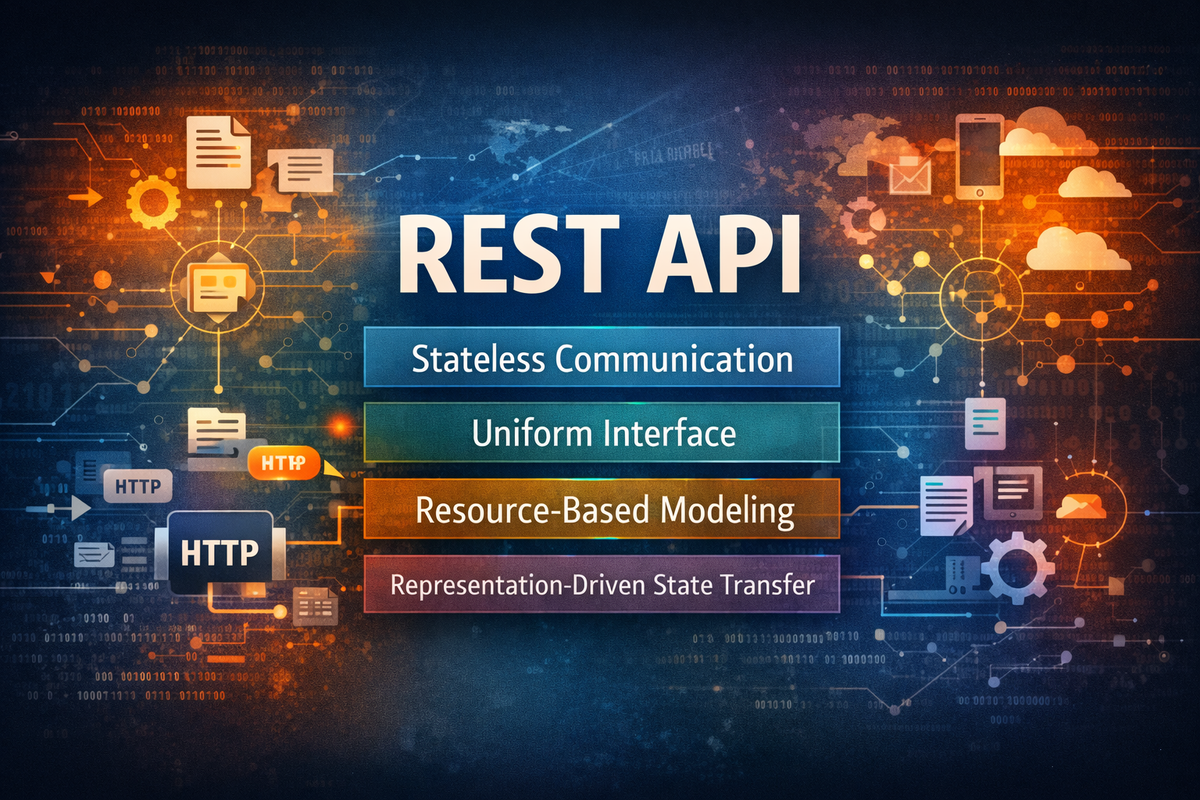
In this post, we will dig deeper into four of the most relevant REST constraints:
- Stateless communication
- A uniform interface
- Resource based modeling
- Representation driven state transfer
We will focus not only on what they are, but also on what they imply for designing and implementing APIs in the real world.
Stateless Communication
Statelessness is one of the most frequently cited REST constraints, and also one of the most misunderstood.
In a stateless system, the server does not store any details about the requests sent by the client. Each request must contain all the information needed for the server to understand it and process it correctly.
This does not mean the server has no state. Servers obviously store data. What statelessness forbids is server side session state tied to a specific client interaction.
What statelessness looks like in practice
A stateless request typically includes:
- Authentication or authorization credentials
- Pagination or filtering parameters
- Localization preferences
- Content negotiation headers
Nothing is implicitly remembered from previous requests.
For example, if a client retrieves the second page of a list of books, the request must explicitly specify that page. The server should not assume that the client previously requested page one, this translates into even if the UI has a "next" button, the request cannot say "next" it must explicitly request the page by number.
Why statelessness matters
Statelessness has profound implications for scalability and reliability.
Because requests are independent, any server instance can handle any request. This enables horizontal scaling, load balancing, and fault tolerance. If one server goes down, another can pick up the next request without needing to reconstruct context.
Statelessness also improves observability. Each request is self describing, which makes logging, debugging, and tracing far more effective.
The tradeoff
Statelessness can feel inefficient at first. Sending authentication tokens and metadata on every request may seem redundant. However, this overhead is usually negligible compared to the operational benefits gained.
When APIs violate statelessness by relying on hidden server side context, they often become brittle. Debugging becomes harder, scaling becomes constrained, and subtle bugs appear when requests are handled out of order or by different servers.
A Uniform Interface
The uniform interface is arguably the most important REST constraint. It is what allows clients and servers to evolve independently.
A uniform interface means that interactions follow a consistent and predictable pattern, regardless of the resource being accessed.
In REST, this uniformity is achieved primarily through:
- A fixed set of HTTP methods
- Standardized status codes
- Consistent use of headers
- Clear separation between resource identity and representation
Separation of concerns
The uniform interface enforces a clean separation between:
- What is being acted, identified by the URL
- How it is being acted, defined by the HTTP method
For example:
GET /books/VE101
PUT /books/VE101
DELETE /books/VE101
All three requests target the same resource. The difference lies entirely in the method. This consistency allows clients, intermediaries, and tooling to reason about behavior without custom logic.
Why uniformity matters
Uniform interfaces reduce coupling. Clients do not need to understand special rules for each endpoint. They can rely on shared semantics across the entire API.
This is also what enables caching, proxies, gateways, and other developer tools to work effectively. These systems understand HTTP. When APIs respect its semantics, they benefit from an entire ecosystem for free.
When APIs deviate from a uniform interface by embedding actions in URLs or inventing custom conventions, they lose these advantages and become harder to integrate.
Resource Based Modeling
Resources are the core abstraction in REST. Everything revolves around identifying, naming, and manipulating resources.
A resource is not a database table, a class, or a DTO. It is a conceptual mapping to something meaningful in the problem domain.
Thinking in terms of resources
A resource represents a noun, not a verb. Books, authors, users, enrollments, and waiting lists are all examples of resources.
Actions are expressed by applying HTTP methods to resources, not by turning actions into endpoints.
Instead of:
POST /borrowBook
A resource oriented design might use:
POST /books/VE101/borrowings
Here, borrowing is modeled as a resource related to a book, not as an imperative command.
Why resource modeling matters
Good resource modeling decouples the API from internal implementation details. Resources can span multiple tables, services, or workflows without exposing that complexity to clients.
When APIs expose internal models directly, any internal refactoring risks breaking external consumers. Resource based modeling creates a stable contract that can outlive backend changes.
This also improves communication. Resource names reflect business language, making APIs easier to understand for both developers and stakeholders.
Representation Driven State Transfer
The final piece of REST is often the least understood, even though it is at the heart of the name itself.
Clients and servers do not exchange objects or database records. They exchange representations of resources.
A representation is a snapshot of a resource’s state at a point in time, encoded in a format such as JSON, XML, or HTML.
Representations are not the resource
This distinction is subtle but important. A resource exists independently of any particular representation. Multiple representations of the same resource can coexist, differing in format, language, or level of detail.
For example, a book resource might be represented as:
- A compact JSON object for mobile clients
- A richer HTML document for browsers
- A localized version in a different language
All of these are valid representations of the same resource.
State transfer through representations
Clients interact with the system by transferring representations back and forth. They retrieve representations, modify them, and submit them back to the server.
The server interprets these representations and updates the underlying resource state accordingly.
This is why REST emphasizes content negotiation and representation formats. It allows systems to evolve by introducing new representations without changing resource identities.
Practical implications
Designing APIs with representation driven state transfer in mind encourages:
- Clear separation between internal models and external contracts
- Forward compatibility through extensible payloads
- Honest communication about system state and consistency
When APIs conflate representations with internal models, they become harder to evolve and more prone to breaking changes.
Bringing It All Together
The REST constraints are not arbitrary rules. They are design principles that emerged from real world experience building large scale distributed systems.
Stateless communication enables scalability and resilience.
A uniform interface reduces coupling and improves predictability.
Resource based modeling creates stable, meaningful abstractions.
Representation driven state transfer enables flexibility and evolution.
Ignoring these constraints does not make an API unusable, but it does increase long term cost. APIs that respect these principles tend to be easier to reason about, easier to integrate, and more resilient to change.
REST is not about perfection. It is about discipline. Applying these constraints thoughtfully leads to systems that age gracefully rather than accumulating hidden complexity.
Finally, if you like what you read or resonate with my opinions. Please subscribe, it's free!