System Stewardship: Lessons from the Gaming Table
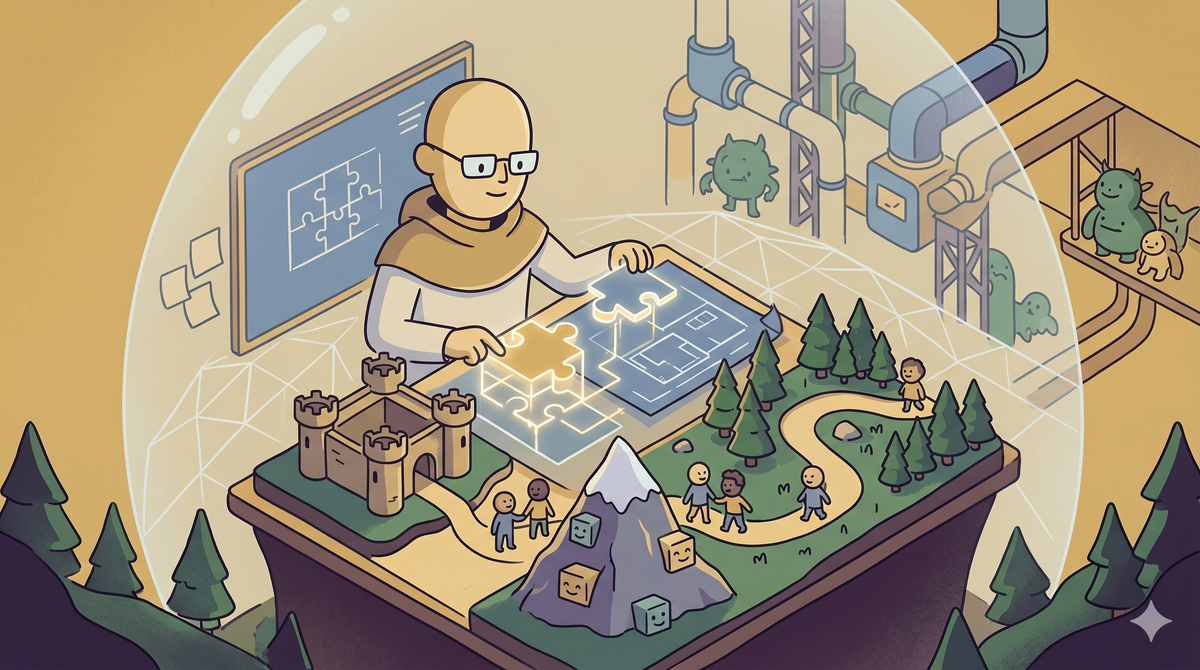
I've been hooked into Dungeons & Dragons these days, playing with my family and designing fun and engaging campaigns. It's been quite fun and challenging to do, especially because I'm playing with my two daughters (9 and 5 years old), trying to incorporate challenges that have to do with stuff they're studying at school or they've shown interest in and their attention span is not the largest.
I've also been more and more involved in Engineering Leadership at work, influencing or defining strategy and enabling teams to execute more effectively and I can't help but to find a lot of similarities between my role as a Dungeon Master at home in our Roleplaying campaigns and my role at work as an Architecture Principal
Designing the System, Not the Solution
As a Dungeon Master, I don't tell players what to do, I only define the system. And by "the system" I mean a few things:
- The rules of the world
- The constraints
- The available signals
- The consequences of actions
From there, the system is handed over to the players.
This mirrors good engineering leadership. The goal is not to dictate solutions, but to design environments where teams can make good decisions autonomously. When a Dungeon Master starts steering players toward a predetermined outcome, the game becomes brittle and boring. When an engineering leader over-specifies solutions, the team becomes biased towards a way of doing things, losing their ability to think creatively and come up with better solutions.
In both cases, the real work happens before anyone takes action. In Engineering, most of the real work happens in planning and designing the solution, in Roleplaying, most of the work happens while creating the campaign and defining the world
Managing Complexity Without Exposing It
Behind the scenes, a Dungeon Master is juggling a lot of things:
- Rules from the game itself
- Narrative threads from the campaign, depending on the player's actions
- Character abilities
- World state
- Improvising when characters take paths I didn't anticipate
The players, however, should never see that complexity directly. They interact with a coherent, consistent world.
This is exactly how good systems are built. Internal complexity exists, but it is hidden behind clean interfaces. Players do not need to know how the world is implemented. They only need to trust that it behaves consistently.
A Dungeon Master who constantly explains mechanics breaks immersion. An engineer who leaks internal details breaks abstractions.
Interpreting Intent, Not Just Inputs
One of the most important skills of a Dungeon Master is interpreting intent.
When a player says, “I want to scare the guard away,” they are not asking for a specific rule invocation. They are expressing an intention. The Dungeon Master’s job is to translate that intention into mechanics in a way that feels fair and coherent.
This is deeply aligned with good engineering practice. Requirements are rarely precise. Stakeholders often describe what they want in terms of outcomes, not implementations. Engineers must interpret intent, clarify ambiguity, and choose appropriate mechanisms without betraying the original goal.
Misinterpreting intent leads to frustration in both games and systems.
Fairness Over Predictability
A Dungeon Master does not guarantee success, but they do guarantee fairness. The rules apply consistently, outcomes follow logically, and randomness is constrained within known boundaries.
This is a subtle but important point. Players do not need predictable outcomes; they need predictable systems. The same is true in engineering. Users tolerate failure far better than inconsistency.
A fair system builds trust. Once trust exists, participants are willing to take risks, explore, and experiment.
Facilitating Collaboration, Not Competition
Although roleplaying games often involve challenges, the Dungeon Master’s role is not adversarial. Their job is to facilitate collaboration between players and between players and the world.
In engineering terms, this resembles the role of a tech lead or architect who aligns multiple stakeholders:
- Different priorities
- Different skill levels
- Different perspectives
The Dungeon Master creates space for everyone to contribute meaningfully. They adjust pacing, spotlight quieter players, and ensure that no single voice dominates the table. This kind of social orchestration is as important in engineering teams as technical expertise.
Embracing Improvisation Within Structure
No matter how much preparation a Dungeon Master does, players will always do something unexpected.
The role is not to shut that down, but to adapt without breaking the world. Improvisation happens within a structured framework. The rules still apply. The setting remains coherent. The randomness is still present within the same known boundaries.
This balance is one of the hardest things to learn, both in games and in engineering. Overly rigid systems collapse under change. Overly loose systems lose coherence and become unpredictable and chaotic.
The Dungeon Master lives in that tension constantly, adjusting without losing consistency.
Teaching Without Teaching
Perhaps the most striking parallel is that a Dungeon Master often teaches without explicitly teaching.
Players learn:
- How the system works
- What kinds of decisions are rewarded
- Where risks lie
They learn by doing, by observing outcomes, and by reflecting on consequences.
This is how the best engineering environments work as well. Rather than formal instruction, the system itself teaches through feedback. Good defaults guide behavior. Poor choices have visible consequences, but, hopefully, not catastrophic ones.
Why This Resonates With Me
Running a roleplaying game feels less like storytelling and more like system stewardship. It is about maintaining coherence, fairness, and possibility.
That mindset is deeply familiar from engineering work. Whether designing APIs, systems, or teams, the challenge is the same: create structures that allow people to make meaningful good choices without needing constant intervention.
Introducing my family to roleplaying games has made this even more tangible. It is a shared exercise in trust, imagination, and collaboration, all grounded in a system that works because it is designed thoughtfully.
If you like what you've read so far or resonate with my opinions, subscribe to my mailing list, it's free and you'll get all my writings twice a month on your inbox.



Comments ()