Systems, Constraints, and Stories: Roleplaying the Engineering Mindset
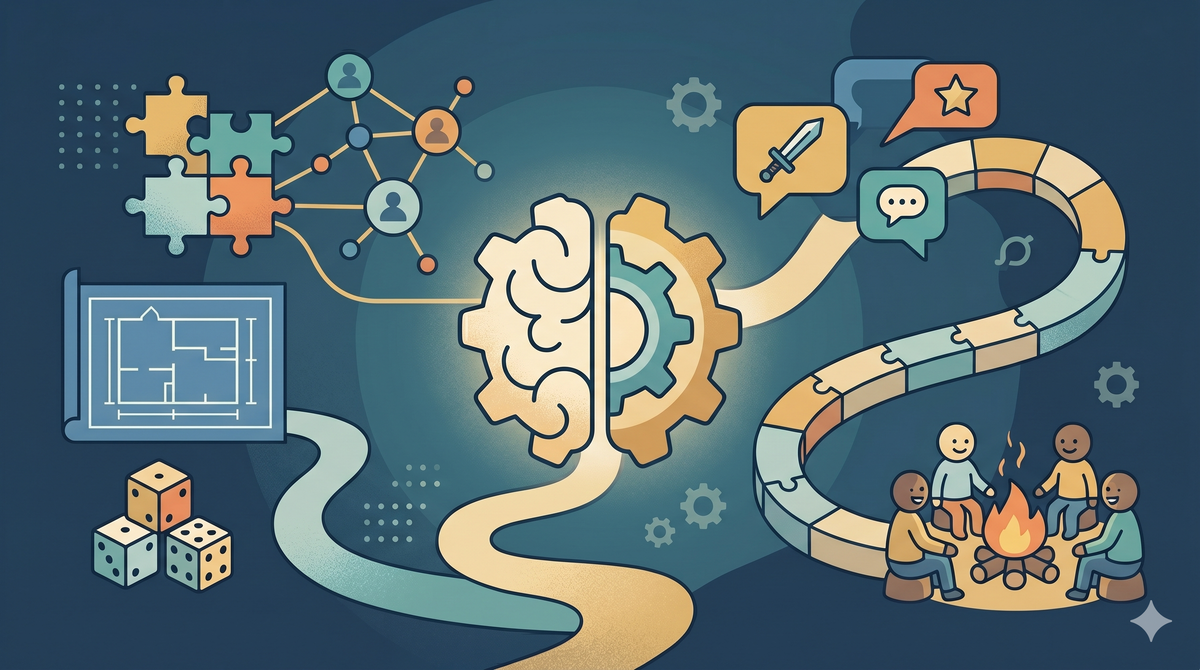
Returning to tabletop roleplaying games felt familiar in an unexpected way. The mechanics, the improvisation, and even the social dynamics all echoed patterns I recognize from years of engineering work.
The more I reflected on it, the clearer it became that roleplaying games exercise many of the same mental muscles that good engineering requires.
Let me share a few Engineering muscles I feel I exercise every time I play or master a Roleplaying game:
1. Systems Thinking and Emergent Behavior
At their core, roleplaying games are systems.
They are composed of:
- Rules
- Constraints
- Actors with different capabilities
- A shared environment
- Feedback loops driven by player decisions
As in software systems, outcomes are rarely the result of a single action. They emerge from the interaction between multiple components over time: players, non-playing-characters, the environment, magic...
This is especially visible in games like Dungeons & Dragons or Vampire: The Masquerade, where a small choice early in a session can cascade into complex consequences later. Engineers will recognize this immediately. It mirrors how seemingly minor design decisions can have long-term effects in distributed systems or APIs.
Research on roleplaying games highlights their capacity to foster systems thinking and holistic reasoning, particularly in collaborative contexts .
2. Constraint-Driven Creativity
One of the most interesting parallels between engineering and roleplaying games is that creativity thrives under constraints.
In RPGs:
- You cannot do everything
- Your character has limits
- The rules define what is possible and what is not
In engineering:
- You work within performance budgets
- You respect interface contracts
- You operate under organizational and technical constraints
Both domains reward creative solutions that work within the system rather than ignoring it. Players who try to “break” the game often miss the point, just as engineers who fight constraints instead of embracing them usually end up with fragile designs, there's usually no "efficient workaround" that lasts.
Studies on RPGs consistently point to their role in developing flexible problem-solving strategies under structured rulesets .
3. Modeling Intent, Not Implementation
Good engineers learn to distinguish intent from implementation. This is something roleplaying games teach remarkably well.
When a player says, “I want to distract the guard,” the group does not immediately jump to mechanics. The intent is discussed first. Only then does the system translate that intent into actions, dice rolls, modifiers, and outcomes.
This mirrors API and system design, where understanding what someone wants to achieve matters more than how they think it should be done. Many failures in engineering appear when we try to mix those two layers.
Roleplaying games repeatedly reinforce the habit of clarifying intent before execution, a skill that carries directly into technical design discussions.
4. Communication, Shared Mental Models, and Alignment
Engineering is a social activity. Most failures are not caused by lack of technical skill, but by misaligned assumptions.
Tabletop RPGs make this visible very quickly. Players must:
- Explain their intentions clearly
- Listen to others’ interpretations
- Align on a shared understanding of the fictional world
If the group does not share the same mental model, the game falls apart.
Research on tabletop roleplaying games shows strong links to improved communication skills, perspective-taking, and collaborative alignment, all of which map closely to effective engineering teamwork .
Introducing roleplaying games in a family setting reinforces this even more clearly. It becomes a safe, low-stakes environment to practice negotiation, explanation, and mutual understanding.
5. Embracing Uncertainty and Incomplete Information
Engineers rarely work with complete information. Requirements evolve, constraints shift, and unknowns emerge late in the process and we must deal with all of them.
Roleplaying games normalize this uncertainty. Players make decisions without knowing:
- All the rules
- The full state of the world
- The consequences of their actions
Rather than freezing, they learn to act, observe feedback, and adapt. This is exactly the mindset required in complex engineering environments.
Research suggests that RPGs can support cognitive flexibility and tolerance for ambiguity, both critical skills in technical problem-solving contexts .
6. Narrative Thinking and Long-Term Design
Finally, roleplaying games are fundamentally about narrative continuity.
Characters evolve.
Worlds change.
Past decisions matter.
NPCs come and go...
This maps closely to long-lived systems. Good engineers design with the future in mind, knowing that today’s decisions will constrain tomorrow’s options. RPGs constantly reinforce the idea that choices accumulate over time and that consistency matters.
In this sense, roleplaying games are an exercise in thinking beyond the immediate solution and considering how systems evolve and how bad decisions can come back in the future to bite your butt
Why This Matters to Me
Returning to roleplaying games did not feel like stepping away from engineering. It felt like reconnecting with a different expression of the same mindset.
For my daughter, it is a playful introduction to structured thinking, collaboration, and imagination. For my wife, it is a shared narrative experience. For me, it is a reminder that some of the most valuable skills we develop as engineers can be practiced around a table, with dice, stories, and shared attention.
If you like what you've read so far or resonate with my opinions, subscribe to my mailing list, it's free and you'll get all my writings twice a month on your inbox.